
Last Updated
Why Boat Accessories Are a Different Category
Backyard grilling gear fails on a boat for three reasons: salt corrosion, motion, and storage volume. A chrome-plated tool set that lives happily on a patio for ten years will show orange pitting after one coastal season. A tall chimney starter is useless where you have no charcoal and no flat surface. A 20-inch spatula does not fit in any locker on a 26-foot boat.
The filter for marine gear is simple: 316 stainless or silicone, compact or nesting, and something that can be secured so it does not become a projectile.
Everything below is chosen against those three tests.
Grill Cover: The Highest-Value $40 You Will Spend
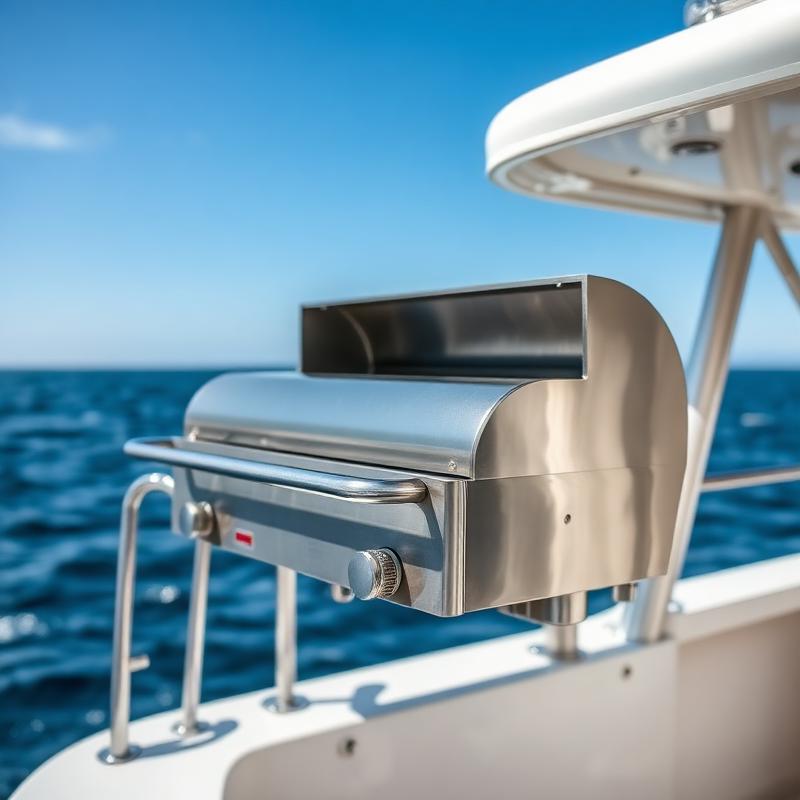
Salt spray is the single biggest killer of marine grills. Not the cooking, not the heat — the film of salt that sits on the burner, the igniter and the venturi between uses and draws moisture out of the air continuously.
A fitted marine cover (Magma and Kuuma both make model-specific covers, $35–$60) goes on as soon as the grill is cool. Look for a Sunbrella-style acrylic canvas rather than vinyl: vinyl traps condensation against the stainless, which is worse than no cover at all.
Generic grill covers do not work here. They flog in the wind at 30 knots and end up in the water.
Tools: Short, Stainless, and Nesting
You want a compact set — tongs, a spatula, and a fish turner — in 304 or 316 stainless with no plated finishes and no wooden handles. Wood swells, splits and grows mildew in a damp locker.
A folding or nesting set that lives in a single roll-up pouch is worth the small premium. Magma's marine tool set runs about $40; a generic stainless camp set at $20 works nearly as well if the finish is solid stainless throughout.
Silicone-tipped tongs are worth having aboard for non-stick and for handling fish. A fish spatula is the single most useful tool on a boat, because most of what you cook out there came out of the water an hour ago.
Skip: bamboo skewers (they blow away), any tool with a plastic hanging loop (UV destroys it), and long-handled backyard sets that will not stow.
Fuel: Canisters, Adapters and Safe Storage
Most marine grills run 1 lb disposable propane canisters. They are convenient and they are expensive per BTU. Two upgrades worth considering:
Low-pressure adapter hose — lets the grill run off the boat's existing propane locker system through a regulator. Cleaner, cheaper long-term, and no loose canisters. Only do this if your boat has a proper vented propane locker and a solenoid shutoff. This is not a DIY plumbing job for a novice.
Refillable 1 lb canisters — legal to refill in some jurisdictions and not others, and a genuine safety consideration. Check your local rules; do not assume.
Storage rules that matter: propane is heavier than air. A leaking canister in a below-deck locker fills the bilge and waits for a spark. Store canisters in a vented deck locker that drains overboard, or on deck secured in a bracket. Never in a cabin, never in a lazarette that drains into the bilge.
Pro Tip: Carry one more canister than you think you need. A 1 lb canister gives roughly 90 minutes of cooking at full output, less in wind.
Cleaning Gear for a Boat
You have no hose, limited fresh water, and nowhere to dump grease. That changes what works.
A wood scraper paddle beats a wire brush on a boat — no bristles to lose over a cockpit sole, no rust. Nylon or brass brushes are the alternative for cast iron plates; avoid carbon steel wire, which corrodes and sheds.
A cast iron scrub pad or chainmail square in stainless handles baked-on residue with just hot water.
Bio-degradable degreaser matters if you are cleaning at anchor. Whatever runs off your grate goes in the water. Use a marine-safe, phosphate-free cleaner, and catch what you can with paper towels first.
Grease catch cups — check that your grill has one, and empty it into shore-side waste. Grease over the side is both illegal in most waters and genuinely bad practice.
Nice-To-Have Gear That Earns Its Locker Space
Instant-read thermometer — waterproof rated (IP67 minimum) or it dies in a month. The [Thermapen ONE](/review/thermoworks-thermapen-one) is IP67 and survives a dunking.
Cast iron griddle plate sized to your grill — turns a small marine grill into a breakfast setup and stops small fish and vegetables falling through.
Silicone basting brush — bristle brushes shed; silicone does not.
Fitted cutting board with a juice groove and non-skid feet, so it stays put on a moving surface.
A wind screen — a simple folding stainless screen makes a bigger difference to cook times in 10+ knots than any upgrade to the grill itself.
Read our [boat grill mounting hardware guide](/guide/boat-grill-mounting-hardware-guide) next, and the [best boat grills roundup](/best-of/best-boat-grills) if you have not chosen a grill yet.
Ready to find your perfect grill?
Browse All Reviews →