
Last Updated
The Mount Is Not Included — Budget For It
Almost every marine grill on the market ships without a mount. The grill is one purchase, the mount is a second, and the two have to match the fitting on your boat. Expect to add $60–$160 on top of the grill price.
There are four realistic mounting options: rail mount, rod holder mount, deck/flat-surface mount, and combination levelling mounts for sailboats. Each solves a different problem, and the right choice comes down to what hardware your boat already has and where the exhaust and dock lines run.
Before you buy anything, measure two things: the outside diameter of the rail you plan to mount to, and the inside diameter of your rod holders. Those two numbers determine everything else.
Pro Tip: Measure your rail with calipers, not a tape. Most marine rails are 7/8", 1" or 1-1/4" OD, and mounts are sold to those exact sizes — a quarter inch off and the clamp will not close.
Rail Mounts: The Default Choice
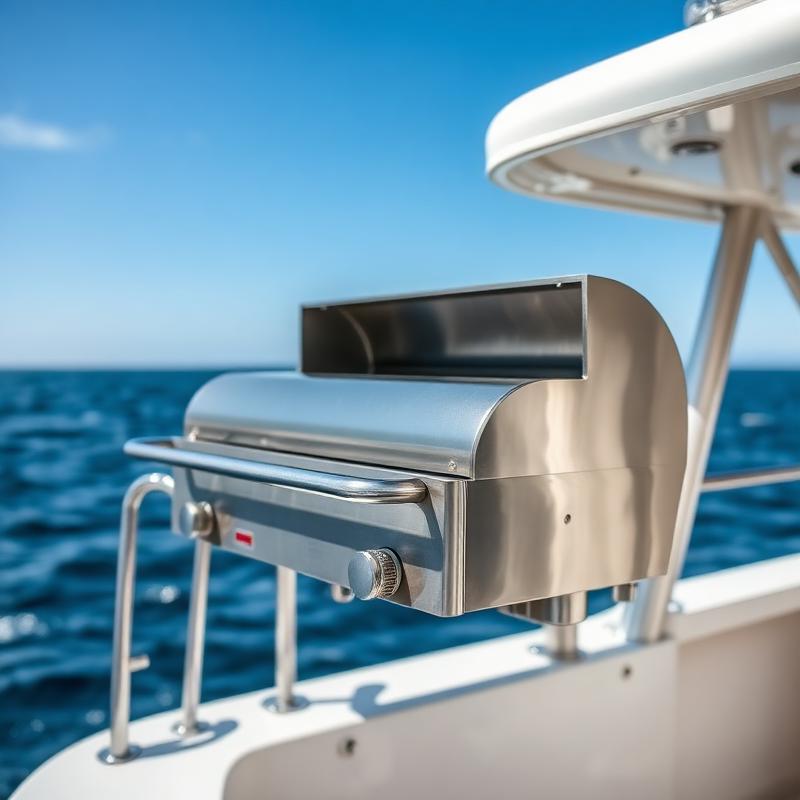
A rail mount clamps around a stanchion or a section of horizontal railing and holds the grill outboard of the cockpit. This is the most common setup because it keeps the heat and the drips over the water instead of over your gelcoat.
Magma's rail mount system (roughly $90–$130 depending on size) uses a two-piece clamp with a levelling ball joint, so the grill stays flat while the boat heels or rocks. That levelling joint is the feature that separates a real marine mount from a generic bracket. Without it, a two-foot swell tips grease straight onto the deck.
Rail mounts want a solid, well-backed rail. If your stanchions flex when you lean on them, they will flex more with a 25 lb grill and a full propane canister hanging off the side. Check the backing plates under the deck before you commit.
Pro Tip: Mount on the leeward side and aft of the helm. Smoke drifts, and nobody wants a cockpit full of it while docking.
Rod Holder Mounts: Cheapest and Strongest
If your boat has flush-mount or gunwale rod holders, a rod holder mount is usually the best structural option. The post drops straight into the holder, which is already through-bolted into a reinforced part of the hull, and the load is carried vertically instead of as a side torque on a rail.
Cost is lower too — typically $60–$90. The standard rod holder is a 1-1/2" inside diameter tube, and most marine mounts are built to that spec. Some older or imported boats use 1-5/8", so measure.
The trade-off is that you lose a rod holder while cooking, and the grill sits at whatever angle the holder is raked to. Look for a mount with an adjustable levelling head — most rod holders are angled 15–30 degrees outboard, and a fixed post will hold your grill at that same angle.
Deck and Flat-Surface Mounts
Deck mounts through-bolt a socket into a flat section of gunwale, coaming or swim platform. This is the sturdiest option and the only real choice on pontoons, center consoles without usable rails, and boats where the rails are too light to trust.
Installation means drilling holes in your boat, which is where most owners stop. If you do it: use a backing plate, bed everything in marine sealant (butyl tape or 4200 — avoid 5200 unless you never want to remove it), and over-drill and fill the holes with thickened epoxy first if you are going through cored fiberglass. Water in a core is a far more expensive problem than a grill.
Many deck mounts accept a removable post so you can pull the grill off and cap the socket flush when you are underway.
Sailboats: Levelling Matters More Than Anything
On a sailboat under way, the boat heels and the grill does not care. A gimbal or ball-joint levelling mount on the stern rail is standard practice — mounted aft of the backstay, on the leeward quarter, where the apparent wind carries smoke away from the cockpit.
Magma and Kuuma both sell levelling mounts designed for this. Expect $110–$160. The important spec is how much travel the joint allows: 15 degrees is fine at anchor, 30 degrees is what you want if you ever cook while sailing.
Honestly, most cruisers grill at anchor. If that is you, a simpler rail mount saves money.
Hardware You Will Need Beyond the Mount
Grill cover — salt spray gets everywhere. A fitted marine cover costs $35–$60 and doubles the life of the burner and igniter.
Storage case or bag — a padded case keeps the grill from marking up the lazarette and stops it sliding around underway.
Propane canister holder — a dedicated bracket for the 1 lb canister so it is not rolling loose in the cockpit. Do not store spare canisters below deck; propane is heavier than air and pools in the bilge.
Stainless fasteners only — if you are through-bolting anything, use 316 stainless hardware. Zinc-plated hardware will bleed rust streaks down your topsides in one season.
Tether or lanyard — a short stainless lanyard between the grill body and the mount. Mounts fail, and a grill going over the side at 4 knots is gone.
Pro Tip: Buy the mount from the same manufacturer as the grill. Cross-brand fitment on marine grills is inconsistent and returns are a hassle once you have drilled anything.
What to Buy
If you have rod holders: a rod holder mount with a levelling head. Strongest, cheapest, no drilling.
If you have solid rails and no rod holders: a levelling rail mount sized to your exact rail OD.
If you have neither: a through-bolted deck socket, installed properly with a backing plate and sealant.
Pair any of these with a 316 stainless grill — see our [Magma Marine Cabo review](/review/magma-marine-cabo-gas-grill) for the standard two-person setup, or the [best boat grills roundup](/best-of/best-boat-grills) for the full comparison.
Ready to find your perfect grill?
Browse All Reviews →